The Running Order: Why a Show’s Sequence Matters
A running order shapes contrast, pace and progression, helping producers place each act or segment where it can hold attention and serve the show.
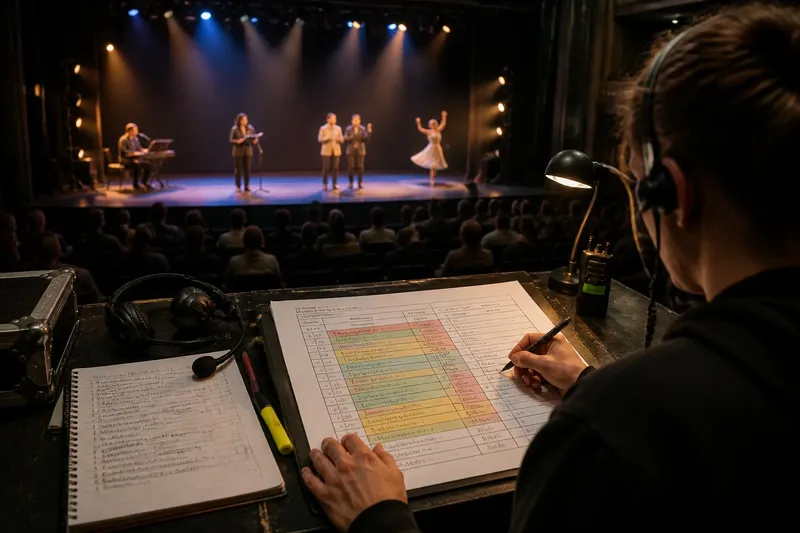
A running order can make a varied show feel like one evening rather than a stack of unrelated items. In a comedy bill, a concert, a panel programme or a staged showcase, the sequence determines what the audience has just experienced, what they are ready for next and what the ending can mean. The running order is not merely a list of start times; it is the production’s main tool for shaping contrast and momentum.
The useful question is not simply which act is strongest. It is what each item asks of the audience, and how that demand changes after the item before it. A quiet story may give a noisy performance room to land. A dense discussion may need a brief visual segment before another stretch of speech. Arrange the show around these relationships, and the individual parts begin to carry more than their own content.
Start with the show’s promise
Before placing segments, write down what the audience should feel the show is building towards. That promise might be a sense of discovery, a shift from intimacy to spectacle, or a final return to an idea introduced early on. It need not be a theme stated aloud. It should, however, give producers a reason to choose one sequence over another.
List each item with a short description, its approximate duration as supplied by the production, the people and technical resources it needs, and the kind of attention it demands. Useful descriptions are concrete: “solo acoustic song, restrained delivery” tells you more about sequencing than “music”. Note whether a segment relies on a set change, a microphone handover, a video cue, audience participation or a particular performer being ready backstage.
Then consider the audience’s experience of each item. Does it ask them to listen closely, laugh, watch movement, follow an argument or take part? These demands are not interchangeable. A sequence of thoughtful spoken pieces may be coherent yet tiring; several high-energy items in a row may leave the next one with little room to register. The running order should give the show shape without sanding away its variety.
When the bill is mixed
For a variety bill or showcase with unlike acts, use contrast as the organising principle. Compare neighbouring items by sound, scale, tone and form. A large ensemble followed by a single performer changes the visual field; a rapid comic exchange after a slow song changes the audience’s listening posture. Such shifts can make each act more distinct, provided the change feels deliberate rather than arbitrary.
A useful starting point is to group items that share a practical requirement, then look for safe and workable transitions between groups. A run of performers who all need the same stage arrangement may reduce unnecessary resets. But a long stretch of similar material can flatten the audience’s sense of change. Break that run with a contrasting form, or vary the tone within it, rather than treating convenience as the only principle.
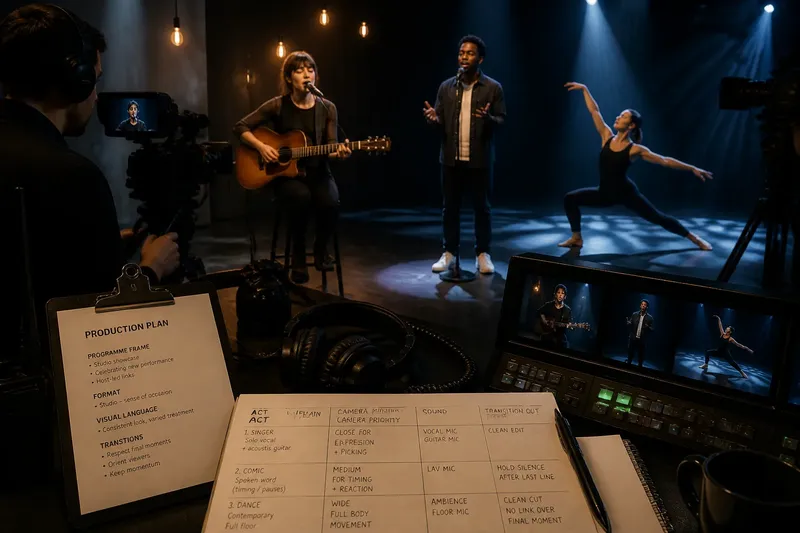
Imagine a small showcase with a spoken-word piece, a comic duet and a short dance performance. If the spoken-word piece is intimate and the dance uses the full stage, placing the duet between them could let the room shift gradually from close listening to movement. If the duet depends on a prop that takes time to clear, the production may instead place it where that change can happen without interrupting a fast transition. The expected observable result is a sequence that feels paced while allowing the crew to make each handover cleanly.
Do not assume that the most polished act must open or close. An opener has to establish the show’s terms and invite attention; a closer has to give the audience a satisfying sense of arrival. A technically confident act can do either, but fit matters more than rank. Consider whether its tone welcomes the room, whether it needs context, and whether its final image or idea can carry the ending.
When the show tells a story
For a scripted production, a narrative concert or a programme built around a clear subject, sequence should support progression. The audience needs enough information to understand what changes, but not so much repetition that the change becomes obvious before it has happened. Arrange scenes or segments so that each one alters the situation, deepens a question or changes the audience’s understanding.
Make a simple beat map beside the running order. For each item, note what the audience knows at its start and what is different by its end. If several consecutive segments deliver the same kind of information without changing the stakes or viewpoint, consider whether they can be shortened, combined or separated by a contrasting moment. This is not a rule that every item must deliver a twist; a pause, a visual image or a return to a motif can also mark progress.
For a subject-led programme, arrange the material so that context arrives before the details that depend on it. A later segment can then complicate or challenge what the audience has heard, rather than asking them to assemble the premise from fragments. The opening need not explain everything. It should give people enough orientation to follow the next move.
When pace is the priority
For a short-form broadcast, awards programme or tightly timed live event, pace and transitions may take precedence over a broad narrative arc. Here the running order needs to account for the difference between a segment’s advertised duration and the time it occupies in the room. Applause, entrances, exits, music cues and brief host links all take space. If these are left outside the plan, later items can feel rushed even when their allotted durations look reasonable.
Mark transitions explicitly. Identify who introduces the next segment, whether the set changes in view, what audio or lighting cue signals the shift, and where performers wait before entering. A running order that says only “song, interview, sketch” leaves the production team to invent the connective tissue under pressure. The detail should be sufficient to make the handover legible, without turning the document into a substitute for a cue script or stage management plan.
For a live event with uncertain audience response, use flexible links where possible rather than trying to recover time by cutting essential content on the fly. The host or stage manager should know which transitions can be shortened and which cues are tied to the next item. The right adjustments depend on the production’s agreed plan; changes that affect technical or performer safety belong with the responsible production staff.
When logistics shape the order
Some sequences are chosen because the people and equipment cannot move instantly. A performer may need to change costume; a camera setup may require a reset; a musician may share instruments with another act. These are legitimate constraints, not failures of artistic ambition. The task is to make them serve the audience’s experience where possible.
Use the running order to show both the public sequence and the operational reality. If an act needs time to prepare, place an item in that interval that can hold attention without making the pause conspicuous. If the show is recorded, plan for the material that must be captured in a particular order, while distinguishing recording order from the sequence viewers will see. A producer can retain a coherent final arrangement without pretending every segment was made in the order it appears.
Keep the document readable at a glance: clear segment names, responsible people, locations or stage states, cue notes and transition requirements. Where the production has an established format, use its standard fields. For unfamiliar venues or specialised equipment, follow the venue’s documentation and the relevant manufacturer instructions rather than improvising technical procedures.
How should you choose?
What should open the show?
Choose an opener that makes the format clear and earns attention without using up the show’s strongest later turn. A welcoming, self-contained item often works well when the audience needs to settle into the event; a more intriguing opening can fit a story-led programme that wants to create a question.
Should similar acts sit together?
Place similar acts together when continuity or practical setup helps the audience and crew. Separate them when the run begins to feel monotonous, using a contrasting item to change the sound, scale or mode of attention.
Where does the strongest act belong?
Put it where its particular strength has a clear function: establishing confidence, renewing attention midway or giving the event a memorable close. A single “best act” ranking cannot decide its place without considering the items around it.
How should a running order change?
Revise it when an item’s duration, technical needs, performer availability or role in the show changes. Recheck the transitions on both sides, since moving one segment can alter the pace and practical demands of its neighbours.
Keep the shape visible
A running order is closer to a row of labelled drawers than a verdict on the material: it helps the team see what sits beside what, and what must be accessible at each point. Keep a working version that can change, and make sure performers, stage management and technical departments are reading the same current arrangement. Record meaningful changes clearly rather than relying on a message passed informally.
Before confirming the sequence, read it from the audience’s point of view. Ask what energy the opening establishes, where attention might need a change of texture, what the central stretch is building, and what the ending leaves behind. Then read it from backstage: check the handovers, resources and people required at each point. A running order earns its value by answering both readings at once.
For a running order that feels purposeful, choose the sequence that best fits the show’s promise and constraints, not the one that looks neatest on paper. When each item changes the audience’s attention, understanding or expectation in a considered way, even a diverse programme can feel like a complete event.