A Watch Party Built Around One Costume Change
A watch party built around one costume change gives a small group a shared focus, with simple prompts and reusable materials instead of costly décor.
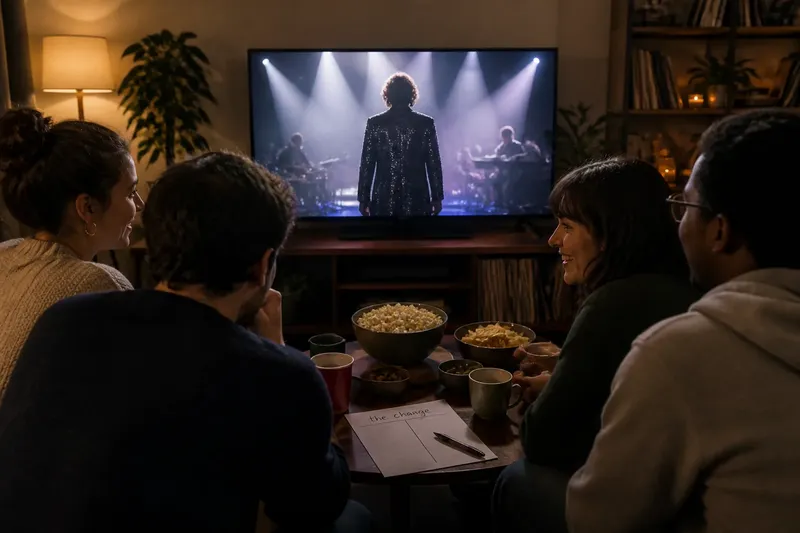
A watch party built around one costume change needs only a screen, a few willing guests and a clear moment to watch for. The costume shift becomes a shared point of attention, not a reason to buy themed decorations or turn the room into a replica of the show.
Say you are inviting four friends to watch a musical variety special in which the lead performer returns after an interval in a sharply different outfit. The change is memorable, but the group includes people who know the show well and people who have never seen it. Your aim is to give everyone a way into that moment without revealing more than the occasion calls for.
Choose the change
Start with one costume change that is easy to recognise on screen. It might be a shift from a pale suit to a dark coat, from formal wear to a bright stage costume, or from a single performer’s look to a coordinated ensemble. A contrast in colour, silhouette or formality gives guests something visible to notice without requiring specialist knowledge.
Check the programme or episode description before settling on the moment. You need to know whether the change appears in the version you will watch and roughly where it falls, but avoid replaying clips if you want the reveal to feel fresh. If the change occurs in a live production, accept that its timing may vary; the gathering can follow the performance rather than a precise clock.
Keep the invitation specific but spoiler-light: “Come over to watch the concert special; there’s one costume change to look out for.” That signals the gathering’s focus without describing the outfit or explaining what the change means. Ask guests to arrive with enough time to settle before the programme begins.
Set a light frame
Use materials already in the house. A sheet of scrap paper, a pen, a few reusable cups and an empty table corner are enough. On the paper, write the performer’s name or simply “the change”; leave room for guests to jot down what they notice. The page acts like a place card at a meal: a small object that tells everyone where to direct their attention.
Do not ask guests to dress as characters or bring props unless that is already part of your group’s fun. A small gathering works best when the focal point stays on the screen. Snacks can be ordinary and easy to serve, so nobody has to leave the room just as the outfit appears.
Before playback, explain the plan in one sentence: “We’ll watch normally, then take a minute after the change to compare what caught our eye.” That makes participation optional. Guests can simply watch, offer a thought, or pass; no one needs to perform expertise.
Use three prompts
Prompts should guide attention, not turn the room into a quiz. Keep them open-ended, and ask one at a time after the change rather than talking over the performance.
- What did you notice first? A colour, a shape, a movement or a change in the performer’s posture can all be valid answers.
- What feels different about the new look? Guests might mention formality, energy or how much of the performer’s outline is visible.
- Did the change alter how you read the moment? Invite an impression, not a claim about what the costume team intended.
Imagine one guest notices the new coat’s bright lining, while another focuses on the performer standing more still than before. You can write both observations on the shared sheet, then ask whether the contrast changed the atmosphere for anyone. The result is a short exchange rooted in what people saw, not a competition to identify hidden meanings.
Let the scene breathe
Watch the scene without pausing unless the group has agreed that a replay would be welcome. A costume change often works through timing: the audience sees the performer leave, waits through music or a transition, then registers the new appearance. Talking through that interval can flatten the moment, so let the screen hold attention.
Afterwards, allow a brief pause before offering a prompt. If guests begin discussing the music, staging or their favourite performer, follow that conversation rather than steering every comment back to clothing. The chosen change is an anchor, not a rule that the whole evening must orbit.
For a group that enjoys looking closely, the host can mention visible details such as fabric sheen, accessories or how the outfit moves under stage lighting. Keep these observations distinct from claims about cost, construction or intention unless the programme itself provides that information. The point is to notice together, not to supply an authoritative interpretation.
Keep the exchange easy
A watch party can include people with different levels of familiarity. Avoid explaining the plot before the scene unless someone asks; a first-time viewer may prefer to form an impression unaided. If the change has a clear story context, let that emerge from the programme or offer a short, neutral explanation afterwards.
Make room for different reactions. One person may find the new look playful, while another reads it as severe. Ask what on screen prompted each response, then leave the disagreement open. Costume communicates through details and context, but viewers do not need to reach a shared verdict for the gathering to work.
For a particularly short change, a note-taking prompt can help without adding equipment. Invite guests to remember one detail and share it afterwards, rather than writing during the scene. This keeps eyes on the performance and avoids turning a relaxed evening into an assignment.
What should guests know beforehand?
Should the invitation reveal the costume change?
Mention that there is one notable change, but keep its appearance undescribed if surprise matters to the group. Guests then know what to watch for without being told what they will see.
What if someone has already seen the show?
Ask them to avoid describing the outfit or its timing before playback. They can still join the conversation by noticing a different detail or listening to first-time viewers’ reactions.
Can the plan work with a film or streamed performance?
Yes, provided everyone can see the same version and the change is clear on screen. If playback includes advertisements or different edits, treat the exact timing as flexible rather than interrupting the gathering to locate a timestamp.
What if nobody wants to discuss the change?
Let the moment pass without prompting a round of comments. The shared focus can be the act of watching; a written note or a relaxed conversation about the rest of the programme is optional.
Reuse the materials
At the end, keep the prompt sheet rather than making a souvenir for every guest. It can be turned over and reused for another screening, or recycled if it has no further purpose. Cups, pens and any simple table covering go back into ordinary use; the event does not need a separate kit.
If you host another gathering, choose a different visual moment rather than repeating the same costume change. A change in lighting or stage arrangement may suit another occasion, but this plan works because guests know exactly what to notice and have room to respond in their own words.
The useful part of a watch party built around one costume change is not the amount of discussion it produces. It is the small pause in an ordinary screening when several people notice the same image, then describe different things within it. A sheet of paper and a considered prompt are enough to make that pause feel shared.