From Variety Bill to Television Showcase
Learn how to adapt a variety bill for television, with clear choices for framing acts, planning screen coverage and making the programme legible to viewers.
A television showcase succeeds or fails in the edit: viewers need to understand where each performance sits, what the camera should notice and how the programme’s format treats its contributors. Adapting a variety bill for television is therefore less about preserving a live stage atmosphere than designing a screen experience with clear editorial and production choices.
Set the programme frame
A live variety bill relies on a venue, a stage and the expectation that performers will follow one another. Television cannot assume viewers share that context. Establish the programme’s premise, setting and tone early, using a host, title sequence or concise opening narration to tell the audience what kind of event they are watching.
Keep that frame distinct from the identity of any individual act. A showcase might centre on new performance, reinterpretation or a particular community of artists. Define the editorial territory, then decide how the programme will introduce its contributors and give them room to perform.
The frame also helps determine production choices. A studio-based show can present the event as a gathering, while a recorded programme can give performances separate visual environments. Neither approach is inherently more faithful to the variety tradition; each makes a different promise to the viewer.
Choose the screen format
A studio format suits a programme that wants an ongoing host presence and a visible sense of occasion. A location-based format can let the setting become part of each performance. A competition format brings evaluation and stakes, so it should be chosen only when those elements genuinely belong to the programme rather than added as decoration.
Make the choice by considering what the performances require. A singer working with a small ensemble may benefit from an intimate set and carefully placed microphones. A physical performance may need an uncluttered floor and camera positions that preserve the full movement. A host-led format needs time for spoken links; a more continuous film may need other ways to signal changes in place or tone.
Think of the format as a picture frame: it directs attention without becoming the subject. The frame can be consistent while each performance receives its own lighting, camera distance and sound treatment.
Shape each performance
For every act, agree on the screen version of the work with the performer and the relevant production staff. Discuss whether the performance should be presented in full, where it begins and ends, and what the camera should follow. These decisions affect not only coverage but also the audience’s understanding of the act.
Prepare a simple coverage plan that names the visual priorities. A close shot may reveal expression; a wide shot can show spatial relationships; a reaction shot can register an audience response but may interrupt a subtle moment. Treat coverage as an editorial choice, not a routine collection of angles.
Sound needs the same attention. A spoken-word piece may require a different microphone arrangement from a band, and recorded music may call for a distinct playback plan. Confirm technical and contractual requirements with the responsible production professional, using the relevant equipment documentation and agreements where applicable.
Frame introductions and links
Introductions should provide information the viewer needs, not simply fill the gap before an act. A brief title card can identify a performer; a host can explain an unfamiliar form or establish why a location matters. If the performance already makes its context clear, begin without an added explanation.
Choose a consistent visual language for the programme, such as a shared title treatment or recurring host position. Then let the visual treatment change where the material calls for it. Uniform graphics need not mean uniform staging.
Plan transitions in the edit as carefully as the performances themselves. A direct cut can preserve momentum; a short host link can orient viewers after a change of setting. If a performance ends on a quiet note, avoid placing a loud or lengthy transition over its final beat.
Production decisions
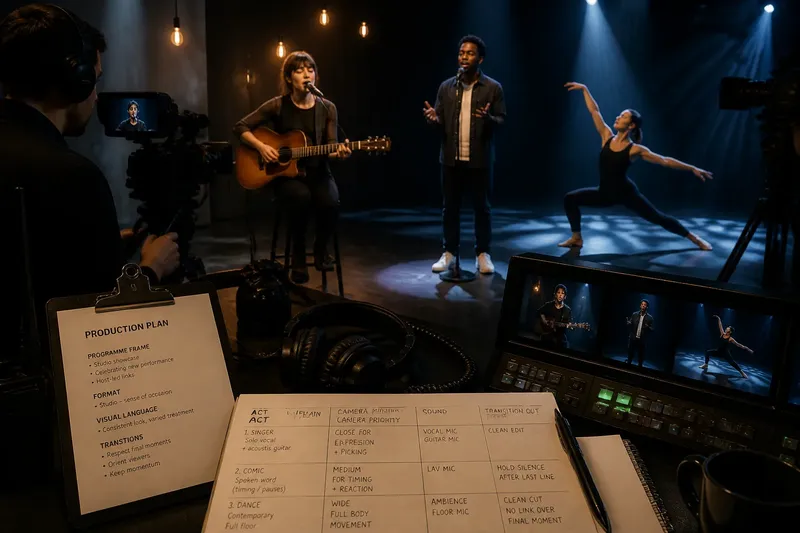
Before filming, make a practical record for each contribution. It should identify the agreed running version, location or set, sound needs, lighting considerations, camera priorities and any required rehearsal or access arrangements. This record gives departments a shared reference without forcing every act into the same technical template.
- Performance boundary: Check that the agreed start and end points are clear; if they are not, confirm them with the performer before scheduling coverage.
- Camera priority: Check whether the act depends on detail, full-body movement or interaction; if detail matters, plan close coverage, and if spatial relationships matter, protect a wide view.
- Sound source: Check whether the act uses live voice, instruments, playback or a combination; if the source is unclear, ask the sound team to confirm the microphone and playback plan.
- Set and movement: Check whether props or movement need an unobstructed area; if the set restricts the action, revise the layout or agree a different performance plan.
- Context for viewers: Check whether the act’s form or setting needs explanation; if viewers need context, prepare a concise introduction, otherwise let the performance begin directly.
- Transition out: Check how the act’s final moment should be preserved; if a spoken link would cover it, delay the link or use a clean edit instead.
Say you are producing an invented studio showcase with a solo singer, a comic spoken-word performance and a dance piece. The singer’s agreed version uses a live acoustic guitar, so the production plan calls for a vocal microphone, an instrument microphone and a close shot that can catch expression. The comic act’s timing depends on pauses, so its plan leaves silence after the final line and keeps the host link out of that beat. The dance uses the full studio floor, so the team clears the set and protects a wide camera view. The resulting decision is to keep the studio format but vary the coverage and transitions for each act, rather than apply one standard setup throughout.
Questions for production?
Should every performance be filmed live?
No. A live studio recording can preserve the feeling of an event, while a separately filmed performance can suit work that needs a particular location or controlled environment. Choose according to the act’s requirements and the programme’s intended presentation.
How much should a host explain?
Give viewers only the context that helps them follow the act or understand its setting. If the introduction repeats what the performance already communicates, shorten it or remove it.
What should a camera plan include?
It should state what the viewer needs to see, which moments require close attention and where a wide view must be maintained. Agree these priorities with the director and performer before filming so the coverage supports the work.
When does a showcase become a competition?
It becomes one when judging, ranking or elimination shapes the audience’s experience. If those mechanisms are absent, avoid graphics and language that suggest contestants are being assessed against one another.
Review the edit
Watch the assembled programme for clarity, not just polish. Check that each act begins at the right moment, that its defining details remain visible and audible, and that titles or host links supply useful context without dominating the work.
Then review the cuts between performances. A television showcase is shaped by what the viewer sees and hears at each handover, as well as by the material on stage. When adapting a variety bill for television, protect the integrity of each act while making the production’s choices easy to follow.