Live Audience or Recorded Applause? Two Ways to Shape a Comedy Show
Live audience or recorded applause changes a comedy show’s timing and intimacy. Compare the production choices to decide which kind of company suits the material.
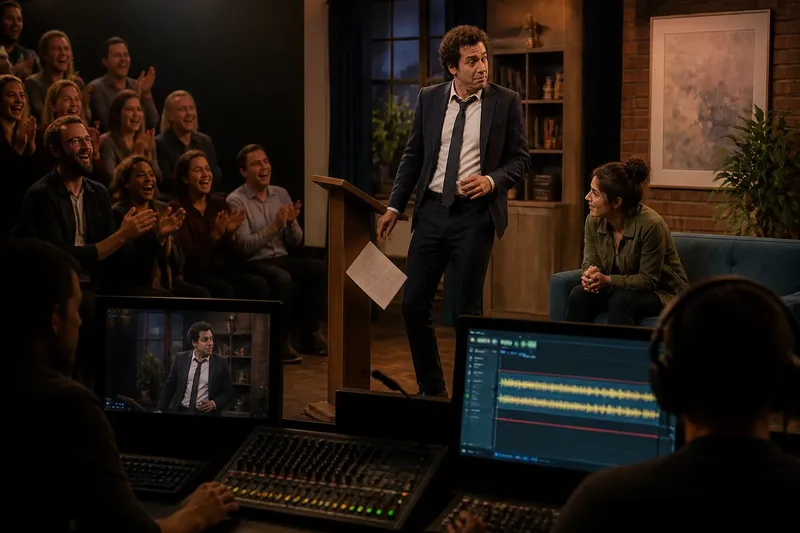
Live audience or recorded applause changes the timing of a comedy scene, not just the sound around it. A roomful of people can make a pause feel shared and unpredictable; recorded laughter lets the production shape a more controlled pulse. Neither choice is simply a mark of authenticity. Each asks performers, editors and viewers to relate to a joke in a different way.
The decision reaches beyond whether laughter is audible. It affects how long a performer can hold a look, how quickly dialogue can follow a punchline and whether the audience seems to share a room with the action. The right format depends on the material’s timing, the production’s working conditions and the kind of closeness it wants to create.
Two kinds of company
A live audience responds in the moment. Laughter may arrive quickly, gather slowly or come in uneven waves. A performer can hear that response and adjust: hold a beat, move on, or let an unexpected reaction breathe. The crowd is not merely an acoustic effect; it becomes part of the performance’s immediate conditions.
Recorded applause and laughter are built into the sound after, or during, filming. The response is selected and placed to support the scene’s pace. That gives the production more control over when laughter begins and fades, but the audience the viewer hears is not reacting in real time to the exact performance on screen. The sound creates a sense of company by design.
These approaches are not always absolute opposites. A show may be performed before an audience but edited to shape its reactions, or filmed without a studio crowd and mixed with audience response. The important distinction is what the sound is doing: preserving a room’s contingent reaction, or composing a deliberate cue for the viewer.
Timing in the room
With a live crowd, a laugh takes up time. A line may land, the room may respond, and the next line must wait until it can be heard. Performers learn to listen for that opening rather than treating every beat as fixed. The resulting rhythm can feel generous and communal, though it may vary between takes or performances.
That variation can be useful when a scene depends on surprise, embarrassment or the sense that events are slipping slightly out of control. A performer’s glance at a fellow actor after a big response can register as a genuine exchange. On the other hand, a sustained laugh can cover a quiet line or interrupt a tightly arranged verbal pattern. Editing has to preserve both intelligibility and the feeling of a real room.
Recorded laughter offers a different kind of timing. The editor can leave a clean gap for a reaction, shorten a pause or place a cue where the scene needs an audible release. This can help dialogue-heavy material keep moving, particularly when its humour relies on quick changes of subject or a carefully balanced sequence of lines.
Control has its own cost. If every response arrives with the same weight and duration, the rhythm may begin to feel prescribed. A look that might have been funny in silence can seem to demand laughter; a small joke may be given a response that makes it feel larger than the scene warrants. The mix needs to make room for the actors, not just announce where the joke is.
The feeling of presence
A live audience tells viewers that other people are watching alongside them. Even through a screen, audible reactions can suggest shared attention: a room has noticed the same awkward pause, and the viewer is invited into that moment. The crowd’s imperfections—an uneven swell, a stray chuckle, a response that trails off—can help make the space feel inhabited.
Recorded applause can create a more shaped version of that companionship. It may give a scene the familiar contours of a group watching together, even when the production was made without a crowd in the room. For viewers who enjoy a clear cue to laugh, that can feel welcoming. For others, a prominent reaction may make the intended response feel too firmly directed.
Silence is part of this choice, too. A comedy can use a pause without any audible audience response, letting discomfort or uncertainty sit with the viewer. A live crowd may still make a sound at the edge of the moment; a recorded track can be left out or held back. In either case, the absence of laughter can be an expressive decision rather than an empty patch in the mix.
Production demands
Capturing a live audience means recording more than voices and dialogue. Microphone placement, room acoustics and the balance between performers and crowd all affect whether the response feels close without overwhelming the scene. The production also has to accommodate an audience’s presence while filming, which can influence blocking, camera coverage and the time available for repeated takes.
Recorded reactions shift much of the work towards sound editing and mixing. The team needs to choose how much response belongs in a moment, how it should vary and how it sits beside dialogue, music and room tone. That does not make the option effortless: a poorly matched cue can call attention to the soundtrack instead of supporting the comedy.
There are practical constraints on both sides. A production may have access to a suitable audience space, or may be working in a location where outside sound and crowd logistics are difficult. The intended format should be considered early enough for performers, directors, camera crews and sound teams to work with it rather than adapt awkwardly after the fact.
Matching format to material
Live response tends to suit comedy that gains meaning from direct exchange: a performer’s command of a room, a character’s public humiliation, or a scene whose energy depends on a crowd reacting together. It can also fit a show that wants the audience’s presence to remain visible in the texture of the performance, including its unpredictability.
Recorded laughter may suit tightly cut scenes, elaborate visual business or dialogue that needs a particularly controlled pace. It can provide a sense of shared amusement while allowing the production to shape pauses around the edit. That does not mean every visual joke needs a laugh cue, or that recorded sound must make a scene feel less human. Placement and restraint matter more than the label.
Imagine a fictional comedy scene in which a character tries to deliver a confident speech while a stubborn prop keeps slipping out of view. The starting material is the same speech, prop and sequence of glances in both versions. In the live version, performers play the scene before a crowd and allow a growing laugh to delay the next line; the observable result is that the speaker’s attempt to regain composure becomes part of the joke. In the recorded version, the editor places a brief response after each revealing glance and keeps the dialogue moving; the observable result is a more controlled rhythm, though it offers less room for the crowd to shape the performance. The trade-off is between responsive timing and edit-led precision.
A useful choice begins with the scene rather than a general preference for one format. Ask what the laughter is meant to tell the viewer. Is it evidence of a room reacting together, or a cue that helps the viewer read the beat? If neither is needed, silence may serve the scene better.
Questions about audience sound?
Does a live audience make comedy more authentic?
Not automatically. A live crowd records a real-time response, but editing, microphone balance and performance choices still shape what reaches the viewer. Authenticity depends partly on whether the sound feels consistent with the scene and the show’s intended relationship with its audience.
Can recorded laughter sound natural?
It can feel integrated when its level, timing and character suit the scene, rather than arriving as a repeated, oversized cue. The mix should leave dialogue and performance at the centre, with the response supporting the moment instead of explaining it too insistently.
Which option suits fast dialogue?
Recorded laughter can make pauses easier to control around tightly edited exchanges, while a live crowd may require performers to wait for reactions to clear. But the scene’s actual rhythm matters more than the format: a live performance can be brisk, and a recorded cue can still interrupt a line.
Can a show use silence instead?
Yes. Silence can leave a joke’s unease, surprise or ambiguity with the viewer rather than assigning it a group response. The choice is especially clear when the scene’s meaning depends on whether a character notices the awkwardness before anyone else does.
A clear way to choose
Choose live audience response when the room’s reaction is part of the performance: when actors can play off it, when communal energy matters, or when a scene benefits from timing that is not wholly fixed in advance. Choose recorded laughter when the edit needs carefully controlled space, when a consistent audience cue supports the format, or when live recording is impractical for the production.
Then consider how much response the material actually needs. A broad group reaction may suit a public embarrassment; a small, brief laugh may be enough for a passing aside; silence may make an uneasy exchange land more sharply. The sound should follow the scale of the moment, not force every joke into the same shape.
For a producer deciding between live audience and recorded applause, the most useful question is not which one sounds more convincing in isolation. Ask what the viewer should feel beside the characters: the energy of a room responding together, or the measured company of a response shaped in the edit. Once that relationship is clear, the production can choose its method and give the actors room to make the timing believable.